
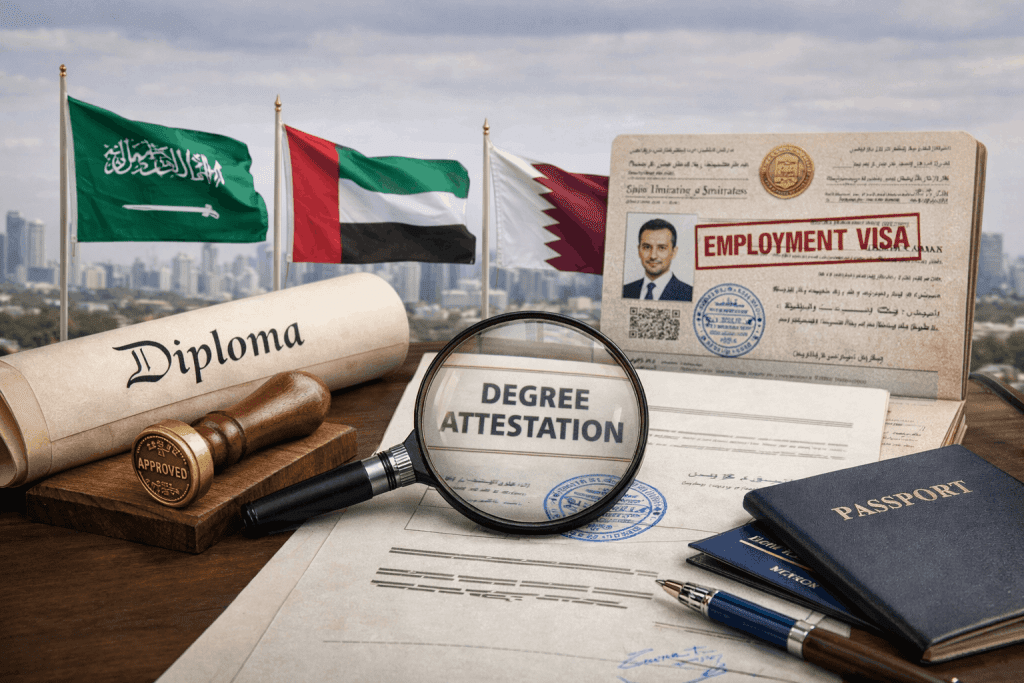
A job offer in the GCC often signals momentum—until progress halts at a single step: degree attestation. What may seem procedural is, in reality, a core compliance requirement embedded within immigration and labor systems across the region.
In countries such as Saudi Arabia, United Arab Emirates, and Qatar, degree attestation is fundamental to validating professional eligibility, securing work visas, and enabling lawful employment.
A Prerequisite for Work Visa Approval
For most professional roles, an attested degree is mandatory for work visa processing.
Authorities rely on verified academic credentials to:
- Approve employment visas
- Issue residency permits
- Formalize labor contracts
Without proper attestation, applications may face delays, reclassification, or rejection—directly impacting onboarding timelines.
Aligning Qualifications with Job Roles
GCC labor frameworks require clear alignment between academic qualifications and designated job roles.
Attested degrees enable authorities to:
- Validate educational background
- Match qualifications to job titles
- Assign accurate profession classifications
This is particularly critical in regulated sectors such as engineering, healthcare, and finance, where qualification relevance is non-negotiable.
Supporting Compliance and Market Integrity
In the GCC, degree attestation functions as a regulatory filter that strengthens trust in the labor market. Authorities rely on this process to verify that academic credentials are both legitimate and issued by recognized institutions, reducing the risk of misrepresentation. By standardizing how qualifications are validated, attestation contributes to a more consistent and reliable talent pool across industries. It ultimately reinforces a system where credibility and compliance are built into every stage of workforce entry.
Enabling Licensing and Career Progression
Beyond initial employment, attested qualifications play a central role in an individual’s long-term career trajectory. Many regulated professions require verified academic credentials as a prerequisite for licensing and regulatory approvals, making attestation essential for entry and continuity within these fields. As professionals advance, the same credentials support promotions, title changes, and expanded responsibilities. Moreover, within the GCC’s interconnected labor landscape, attested degrees facilitate smoother transitions across roles and jurisdictions, enabling greater career mobility and progression.
Avoiding Delays and Disruptions
In practice, attestation is often the difference between a smooth onboarding process and unexpected delays. Even a minor oversight—such as a missing stamp or mismatch in documentation—can slow down visa processing significantly. These delays don’t just affect timelines; they can have a ripple effect on business operations and workforce planning. Addressing attestation requirements early and thoroughly ensures that transitions remain efficient, predictable, and disruption-free.
How Northman & Sterling Can Support
Navigating multi-country attestation requirements can be complex and time-sensitive. Northman & Sterling provides end-to-end support to ensure your documents are processed accurately and efficiently.
Our services include:
- Document review and eligibility assessment
- End-to-end attestation and legalization coordination
- Embassy and MOFA processing
- Advisory on GCC immigration and compliance requirements
Connect with Northman & Sterling to streamline your attestation process and ensure a seamless transition into GCC markets.